
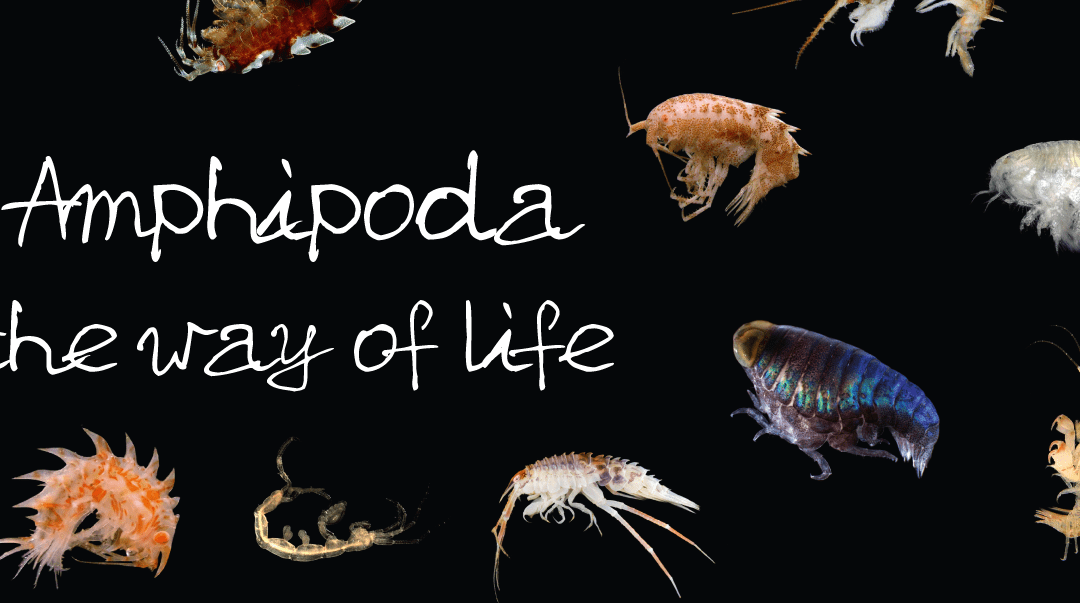
Fifty years of amphipod meetings and counting!
Fifty years of amphipod meetings and counting!

Created by the Grabowski lab for ICA15 – Poland, 2013
DESIGN: Karolina Bącela-Spychalska; PHOTO CREDIT: Arthur Anker, Michał Grabowski, Hans Hillewaert, Anna Jażdżewska, Alexander Semenov
As summer slowly approached its end, Dijon, the beautiful French city surrounded by Burgundy wineries, was suddenly inundated by people dedicated to the study of amphipods – a group of fascinating crustaceans inhabiting all aquatic habitats.
More than 120 people from 27 countries came together at the end of August to share the latest developments in amphipod research relating to everything from taxonomy to ecology, from physiology to behaviour, from phylogeography to cryptic speciation.
What started as a meeting dedicated to one taxon (the groundwater genus Niphargus) has become the International Colloquium on Amphipoda (ICA), a meeting that envelops all amphipods from all habitats. It quickly grew into a friendly, informal environment where researchers and students exchange ideas and start new collaborations. A big family that reunites every two to three years in different countries in the Euro-Mediterranean region.
This year, ICA18 was a particularly special occasion as the group celebrated its 50th anniversary. As plenary speaker José Manuel Guerra-García from the University of Seville put it, “1969 had two major events: the moon landing and ICA1 in Verona, Italy.” His presentation, titled ‘Fifty years of amphipod meetings. Taxonomical, ecological, and behavioural patterns of the amphipodologist community’, detailed the history of this important community of researchers and its rapid growth and diversification during the last decades.
ICA18, organized by Thierry Rigaud and Rémi Wattier from the University of Burgundy, brought new energy, new graduate students, and early-career researchers looking to understand the incredible diversity of amphipods as well as new ideas for future collaborative projects.

Meeting highlights
Nicolas Puillandre from the National Museum of Natural History in Paris gave a plenary talk titled, ‘DNA Barcoding, DNA taxonomy, and integrative taxonomy: separating the wheat from the chaff’. He highlighted the history of DNA barcoding and the growth of its applications, from its restricted sense of specimen identification to the wider applications as part of DNA taxonomy and integrative taxonomy. This was the first ICA meeting to have a plenary talk dedicated to DNA barcoding.
Another first for ICA was the hands-on mini-workshop on BOLD, the online platform that provides an integrated environment for the assembly and use of DNA barcode data, organized by Filipe Costa, iBOL Science Committee member for Portugal, and Pedro Vieira, both from the University of Minho in Portugal; Michał Grabowski, iBOL Science Committee member for Poland, and Tomasz Mamos, both from the University of Łódź in Poland; and myself from the University of Guelph in Canada. After three days of talks and poster presentations, the workshop participants gathered in the beautiful old library room of the Faculty of Sciences and spent an entire Friday afternoon learning about BOLD and how to include it in their workflow so that their data and metadata are stored on a single platform.

Participants to the BOLD mini-workshop organized on the margins of ICA18 in Dijon, France.
PHOTO CREDIT: Maria João Gomez
One of the hottest topics at ICA18 was cryptic speciation, as amphipods are a group known for high intra-specific diversity. The subject triggered an ad-hoc meeting to establish a roadmap for approaches to identifying and describing cryptic species. Due to the complexity of the topic, moderator Michał Grabowski proposed that a core group with representatives from natural history museums, academia, BOLD, and the World Register of Marine Species (WORMS) should continue the discussion online and produce guidelines for the amphipod community to address the topic of cryptic species in the near future.

The final session was dedicated to DNA barcoding and the progress made in freshwater, marine and groundwater amphipods. I had the pleasure of closing ICA18 with an overview of current practices in DNA barcoding amphipods inferred from compiling and analyzing all public amphipod barcode data available in BOLD.
Talks from the final session titled, ‘How many taxa?’
DNA barcode reference library for European freshwater malacostracans: getting there
T Mamos, T Rewicz, K Bacela-Spychalska, K Hupalo, A Jablonska, K Zganec, M Jelic, A Wysocka, L Sworobowicz, D Copilas-Ciocianu, A Petrusek, R Wattier, J Hinić, V Slavevska-Stamenković & M Grabowski
Broad-scale DNA barcode-based meta-species analyses of patterns of molecular variation in Amphipoda from world’s oceans
PE Vieira, C Gonçalves, P Soares, H Queiroga & FO Costa
DNA barcode availability for European groundwater macrocrustaceans
M Zagmajster, Š Borko, T Delić, C Douady, D Eme, C Fišer, F Malard, P Trontelj & A Weigand
What public data can tell us about current practices in DNA barcoding amphipods
AE Radulovici
ICA18 has set the course for a very interesting two years in amphipod research, one that will lead to ICA19 in Tunisia in 2021. I am happy to see more and more people producing DNA barcodes for amphipods which inherently leads to the discovery of new cryptic species (especially in groundwater). Compared to 2010 when I attended ICA14 in Spain, my first amphipod meeting, there is definitely more interest in DNA barcoding, with some research labs widely adopting the tool for their amphipod projects. My biggest hope coming out of ICA18 (and the BOLD mini-workshop) is that amphipodologists will come together to follow best practices when generating DNA barcoding data and metadata so that the entire community will have access to a reliable dataset of amphipod records.
As always, ICA was inspiring and energizing. And if ICA needed a slogan, the phrase coined by the Grabowski lab in 2013 could very well reflect the belief of people gathered in Dijon – Amphipoda is the way of life!
Conference Posters
I highlight some of the poster presentations of interest to the barcoding community. For more information including the authors’ affiliations and abstracts, please refer to the book of abstracts.

Coloring outside the lines: cryptic diversity in podocerid amphipods
BC Cummings & G Paulay
PHOTO CREDIT: Adriana Radulovici
Combining molecules and morphology to describe cryptic new species – the Bathyceradocus genus case
L Corbari, A Jażdżewska & A Ziemkiewicz
Combining artificial substrates, morphology and DNA metabarcoding for investigating marine amphipod communities in NW Iberia
BR Leite, PE Vieira, JS Troncoso & FO Costa
DNA sequencing and morphological analysis of an undescribed Salentinella species (Amphipoda, Salentinellidae) from an anchialine cave in Peloponnese, Greece
D Davolos, C Calcari, E De Matthaeis & C Di Russo
Estimating the actual biodiversity and evolutionary history of the amphipod genus Eusirus in the Southern Ocean
L Salabao, B Frédérich, G Lepoint, ML Verheye & I Schön
First insights into the deep-sea scavengers at hydrothermal vent fields along the Southeast Indian Ridge
K Kniesz, A Jażdżewska, TC Kihara & PM Arbizu
Historic Peracarid Crustacea collections in The Natural History Museum, London
A Herdman, LE Hughes & M Lowe
Syntopic coexistence of gammarid cryptic lineages: rule or exception?
A Petrusek, T Rutová, PK Bystřický, M Gajdošová, A Beermann, P Pařil, M Horsák, D Copilas-Ciocianu & F Leese
The deep-sea Eusiridae from Papua New Guinea waters (SW Pacific Ocean)
I Frutos, JC Sorbe & L Corbari
When one becomes 15: Morphological vs. molecular species delimitation in the “Niphargus aquilex” complex
D Weber, T Brad, A Weigand & J-F Flot
To keep up with the latest research in amphipods, check out the Amphipod Newsletter.
Written by

Adriana Radulovici
Centre for Biodiversity Genomics, University of Guelph, Canada
Don't Miss Out!
Subscribe to the iBOL Barcode Bulletin for updates on DNA barcoding efforts, the iBOL Consortium, and more.


